Showing posts with label books. Show all posts

Thursday, June 16, 2011

Lesson 1 of John Taylor Gatto's Seven Lessons

I intend to homeschool my children...

I'm not anti school and my husband and I certainly will send my children to school if homeschooling is not working out for us or them. But I'm going to try my best to teach them at home.

Why?

The decision to homeschool is based on personal experience of school, observation of my younger siblings who were and are being homeschooled, observation of other homeschooled children, and a desire to raise happy, confident children to will continue to practise their Catholic faith as adults.

So it was with interest that I read John Taylor Gatto's 1992 book Dumbing Us Down. When Gatto stood up to accept the New York State Teacher of the Year award for 1991, without a hint of irony, he listed the seven main lessons that school teaches. They were:
  1. Confusion
  2. Class Position
  3. Indifference
  4. Emotional Dependency
  5. Intellectual Dependency
  6. Provisional Self Esteem
  7. One Can't hide
It's a harsh critique of the American school system and it made me think whether these seven lessons relate to me and my experiences in Australia. So here we go.

LESSON 1: CONFUSION

Gatto writes
The first lesson I teach is confusion. Everything I teach is out of context. I teach the unrelating of everything... Even in the best schools a close examination of curriculum and its sequences turns up a lack of coherence, full of internal contradictions... The logic of the school mind is that it is better to leave school with a took kit of superficial jargon derived from economics, sociology, natural science and so on, than with one genuine enthusiasm.
So, did I experience this confusion as school? I didn't think so at the time, as school was just something that you do because you have to. What was to question?

I do remember desperately wanting to know how all the different history lessons connected together and how did they connect to what I was learning in English. Where did Keats fit into the timeline with Shakespeare or with Medieval history? What was happening elsewhere in the world throughout all the dynasties of China? In that sense all the subjects I learned were tiny isolated islands of facts and figures which did not clearly relate to other subjects or even other topics within the one subject.

And what do I remember of these subjects? Not much, except random things like what is osmosis and who wrote Waiting for Godot. I remember more experiences unrelated to formal lessons such as running out of a religion class after a fight with the feminist teacher, and singing with the choir at an old people's home or being called "Crrrretons!" by our music teacher.

Gatto suggests that genuine learning is not meaningless: it is interconnected. As with the sequences of learning to walk or talk, "every action justifies itself and illuminates the past and the future". So I guess he is talking more about learning through living. Sounds a bit like unschooling to me.

School was not a place I attended  to learn anything I really wanted to: that's what holidays were for. In holidays I read what I wanted, despite the difficulties (oh, the simultaneous pain and joy of skim-reading Gone With the Wind in one day!) and had leisure to sit in the sun and think (happy memories!). As a family we laughed and fought and explored rock pools by the beach. All worthwhile and memorable lessons.

Only as an adult have I been able to explore the interrelatedness of all the random things I was taught at school. Only now have I had the space to explore what I really wanted to explore without the pressure of examinations crowding out substance with assorted facts.

So yes, I can understand what Gatto means when he says the first lesson of school is confusion.

Saturday, May 29, 2010

Jasper Fforde

Is this name a pseudonym? It reminds me of Wodehouse's Freddie Ftich-Fitch. I'm not sure, but I've just finished reading Jasper Fforde's The Big Over Easy, and I loved it so much I just have to blog it.


Jack Spratt heads up the Nursery Crimes police division and has to solve the case of who murdered Humpty Dumpty. It might sound corny but it makes enough of a commentary on the media, politics and celebrity status that it's not all cheese

It was a bit 'parrallel universe', had a lot of satire, and many moments where you don't laugh out loud but you do go "ha" under your breath: it was a great read.
Over dinner I kept telling ever-patient hubby about it but he's not really into the whole 'it's set in our world but not really' themed books so I couldn't go overboard telling him about it.

The first Jasper Fforde book I read was The Eyre Affair, which I also loved.


Who wouldn't want to jump in and out of books and interact with the characters - as long as they you don't speak with them when they are actually in a scene: you don't want to be written into the book!

The part I always remember with a chuckle about this book is when a Japanese tourist Mrs Nakajima  manages to read herself into Jayne Eyer and decides to settle down in the village where Rochester lives.

I just went to Jasper Fforde's website and it's just like reading his books. Hilarious!

.........And no, I wasn't paid by Fforde to write this....

Thursday, May 20, 2010

Does your child eat books?

Last week I was in the library with our Little Man. As we sat down for story time with other mums and kids, I let him play with the book I was going to borrow. He toddled off with it.

Just as the story teller was opening a story about how to treat library books, we all heard a massive Riiiiiiiiipppp sound. Silence. Then a sharp gasp from me as we all turned to see Little Man holding the first page of my book...

... with the rest of the book on the floor.

True story.

Ok so this example is of my child and public property What about books at home?

Kim [sorry, Liz!] at On Giant's Shoulders tells me that her grand daughter loves to eat books, as does my Little Man, although he's more into shredding them. Like the possibly out-of-print second hand Golden books I gave him.

I don't want him to destroy precious books, but I want him to be friends with books, not just acquaintances. I want him to be comfortable with them.

A friend of mine says his 2 year old son covers himself with books at night before he goes to sleep. What better way to get close to your books?

For now, I'm happy for our Little Man to shred, eat and sleep with his (non-precious) books. I think when he gets a bit older I'll start showing him how to be a courtly lover of them.

Wednesday, May 19, 2010

Courtly or carnal lover of books?

In homage to Anne Fadiman

From the moment I started to read books my parents insisted on their proper treatment.

To turn the pages from the edge closer to the spine was illegal in our home. We were taught to lovingly caress our books and turn our pages from the outermost corner with great delicacy.

Books were not meant to be treated harshly by leaving them face down on the page you were on. Dog ears were punishable offences and we never DARED write in our books (even in pencil) ...


I just lurrrved re-covering my mum's old 1964 Oxford dictionary

... in fact we didn't WANT to write in our books. We were courtly lovers. Any precious book was adorned in a pristine cloak of clear plastic and forever preserved in perfection.

It's different for my husband.

Not long after I met my husband he told me with gritted teeth how he once read a Tim Winton book. He hated every minute of it but kept reading in the hope that it would get better. When he got to the end, he claimed to have kicked the book around the room for several hours.

I had to stop and think for a minute if I wanted to continue my relationship with him.


Cue theme music from Psycho... my husband's copy of Furrow.

Writer Anne Fadiman in a brilliant essay describes herself as a carnal lover of books. To her, books are meant to be devoured in word and physicality. Her son at 8 months would eat any book he held.


She says:

To us, a book's words were holy, but the paper, cloth, cardboard, glue, thread, and ink that contained them were a mere vessel, and it was no sacrilege to treat them as wantonly as desire and pragmatism dictated. Hard use was not a sign of disrespect but of intimacy.

Since I got married I have been known to leave a book face down on my bedside table... but as my dad says, it's just plain annoying to to read a book that someone else has written in. How can you decide for yourself what the main points really are?!!

So what are you, a carnal or courtly lover of books?

Tomorrow: how will you let your children treat their books?
A tale of Public Library Embarrassment

Monday, May 17, 2010

Romantic mood and the two Annes

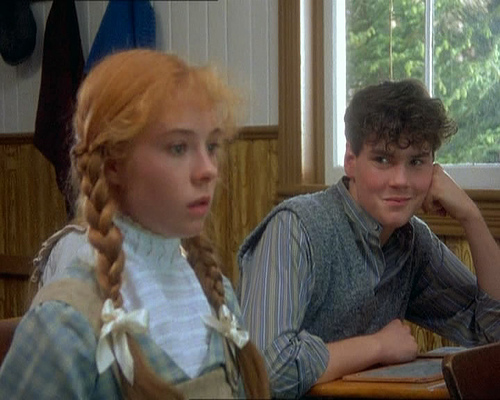
I noticed that the writer of this fantastic blog has just finished re-reading the Anne of Green Gables books. I must admit also to having just the other week skimmed through the last three of the six books. 'Why skimmed?' you ask.

Well I must have been in a bit of a romantic mood and I wanted to get to the juicy parts.... like at the very end [spoiler alert!] when Anne meets the former flame of Gilbert, Christine, who is now a rich and childless society widow. Anne is eaten up with jealousy and it becomes a bit of a page turner...


I love one quote from the last pages of Anne of Ingleside: Christine is very scornful of Anne having had seven children and no longer writing stories. Anne comments:
"I'm writing living epistles now"

Christine doesn't recognise the quote (ha ha!) and neither did I (oh...)  until I looked around the net and I think it's a reference to 2Corinthians:2-3 about Christians being epistles of Christ, written on our hearts. I do love the idea of the parents helping to shape that living epistle.


The other book I skim read in my romantic mood was Persuasion. The  heroine, also called Anne, in the interests of duty, rejects the man she loves only to meet him again 10 years later and is still in love with him. (Oooh, how will it turn out?!!) The parts I love skipping to are when Anne re-meets Captain Wentworth in Bath and also when Anne's rival, Louisa, falls off the Cobb in the town of Lyme Regis.


It seems that I was not the only one impressed by the Cobb scene. Apparently the first thing Tennyson did on a visit to Lyme Regis was go to see the Cobb where "Louise Musgrove fell".  At first I imagined the Cobb to be only a few steps high, but the full drama of the scene is evident when you see how high the Cobb really is.

Romantic indeed!